
Hard water leaves a signature. White crust around faucets, cloudy glassware, scale in a kettle and a water heater that fills with sediment are all common. A softener or a filter can fix most of it, but the right system depends on your water, and the first step is a test.
Water softener and filtration service in Sachse, TX covers whole-home softeners, whole-home filters and under-sink systems. We do not guess at your water. We suggest testing it so the system fits what is actually in it.
What we know about Sachse water
Sachse buys treated water from the North Texas Municipal Water District, whose largest source is Lavon Lake. NTMWD describes its treated water as moderately hard, due mainly to minerals from Lavon Lake. It publishes an annual Water Quality Report, and the City of Sachse is the utility that serves your tap.
The report gives total hardness in milligrams per liter. NTMWD says to divide that number by 17.12 to get grains per gallon, the unit softener makers use. For your actual number, ask the City of Sachse for its latest report, or test your tap at home with a strip kit.
Softener or filter: which do you need
| Problem | Likely answer | Notes |
|---|---|---|
| Scale, spots, soap that will not lather | Water softener | Removes the hardness minerals that cause scale |
| Chlorine taste or odor | Carbon filter | Improves taste and smell, does not soften |
| Sediment or cloudy water | Sediment filter | Catches particles |
| Drinking water quality at one tap | Under-sink filter or reverse osmosis | Treats only the water you drink and cook with |
A softener and a filter do different jobs. Many homes use both, a softener for the whole house and a filter at the kitchen tap.
How a softener works
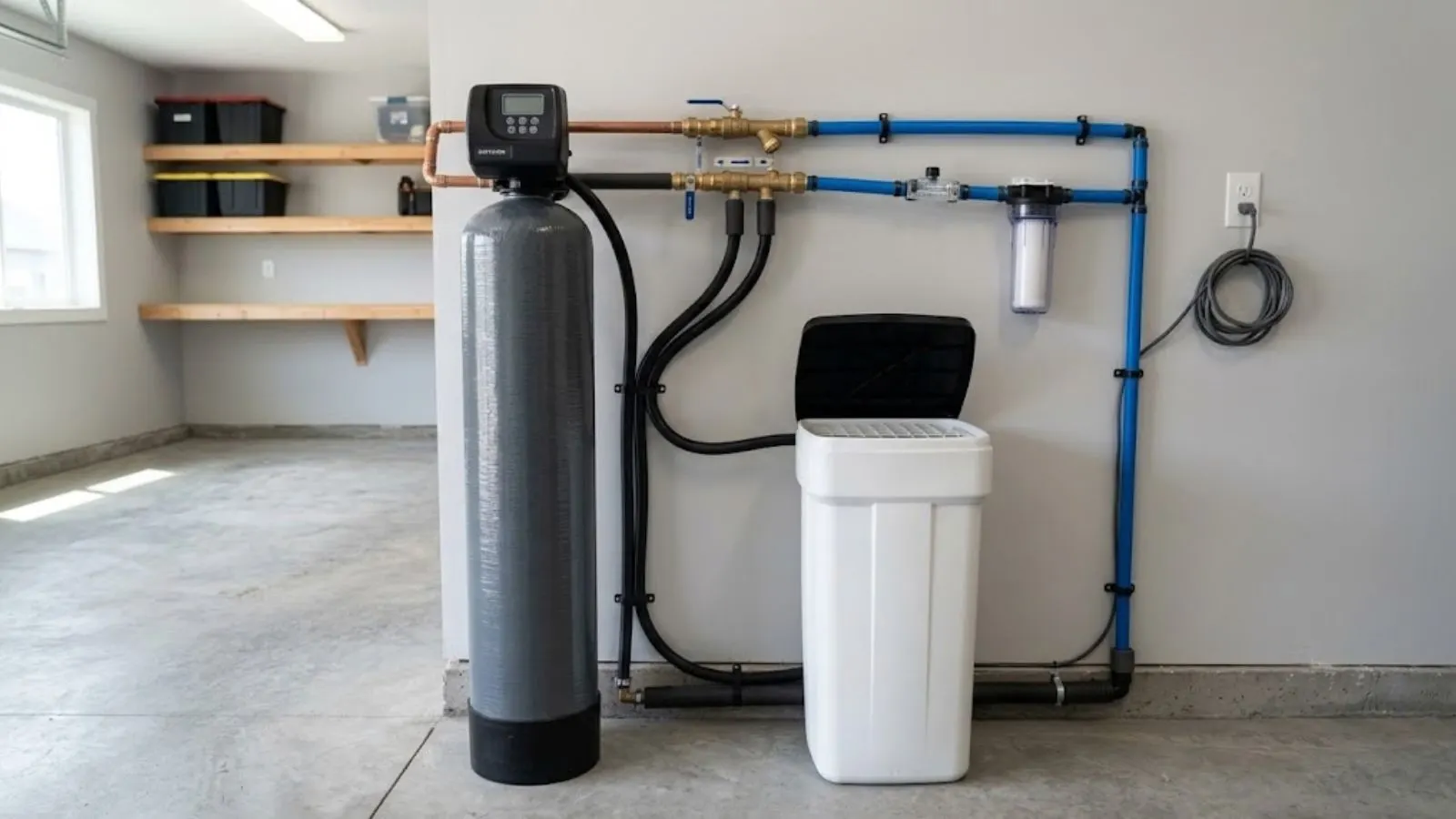
A softener holds resin beads that swap hardness minerals for sodium or potassium as water passes through. When the resin is full, the system regenerates with a brine rinse and flushes the minerals down the drain. That needs a drain connection, a power outlet and salt or potassium to refill the brine tank. Ask about water use and regeneration settings so the system suits your household.
Installing a softener or filter
Test your water
A strip or lab test gives hardness and other readings, and sets the size of the system.
Choose the system
Capacity is matched to household size and the hardness reading.
Install
The unit is connected to the main supply, a drain and power, with a bypass valve.
Set and teach
Hardness and regeneration are programmed, and you learn how to add salt and bypass the unit.
What a softener does for your plumbing
Scale narrows pipes, coats heating elements and shortens appliance life. A softener reduces it throughout the house. That helps tank and tankless water heaters, which are sensitive to mineral buildup, and it helps dishwashers, washing machines and faucets.
Softened water feels different to some people, and it adds a little sodium. People on low sodium diets can ask about potassium or keep an unsoftened tap for drinking.
Limits worth knowing
A softener does not make water safe to drink if it was not already. It does not remove most contaminants, so if your concern is lead, bacteria or something else, the answer is a test and a different system. We say so when it comes up. If you are not sure whether you need a system at all, a test of your tap is the first step.
Test your tap and talk it through
Call and tell us what you notice at the faucets and the water heater.
Water treatment in Sachse homes
Homeowners in Heritage Park, Woodbridge, Sachse Farms and Jackson Meadows all get their water from the same utility, so the hardness reading is similar across town. What changes is the house: its plumbing, its fixtures and how much water it uses. That is what sizes the system.
Water treatment in nearby towns
Hard water is a question in Murphy and Wylie too, since several nearby towns share the same regional supplier.
What a softener or filter costs
Cost factors for water treatment
A written price is set after the test and a look at where the system will go.
Insurance does not cover water treatment. Want your real number? Call (972) 903-8224.
Common questions
Is Sachse water hard?
NTMWD, which supplies the city, describes its treated water as moderately hard. Ask the City of Sachse for its latest water quality report, or test your tap for your own number.
How do I test my water?
A home strip kit gives a rough hardness reading. A lab test gives more detail. A plumber can also test it on site.
Does a softener remove chlorine?
No. A carbon filter handles taste and odor. A softener addresses hardness only.
How often do I need to add salt?
It depends on the water use and the hardness. Most households check the brine tank every month or two.
Will a softener harm my plumbing?
No. It reduces scale. Softened water is safe for pipes and appliances.