
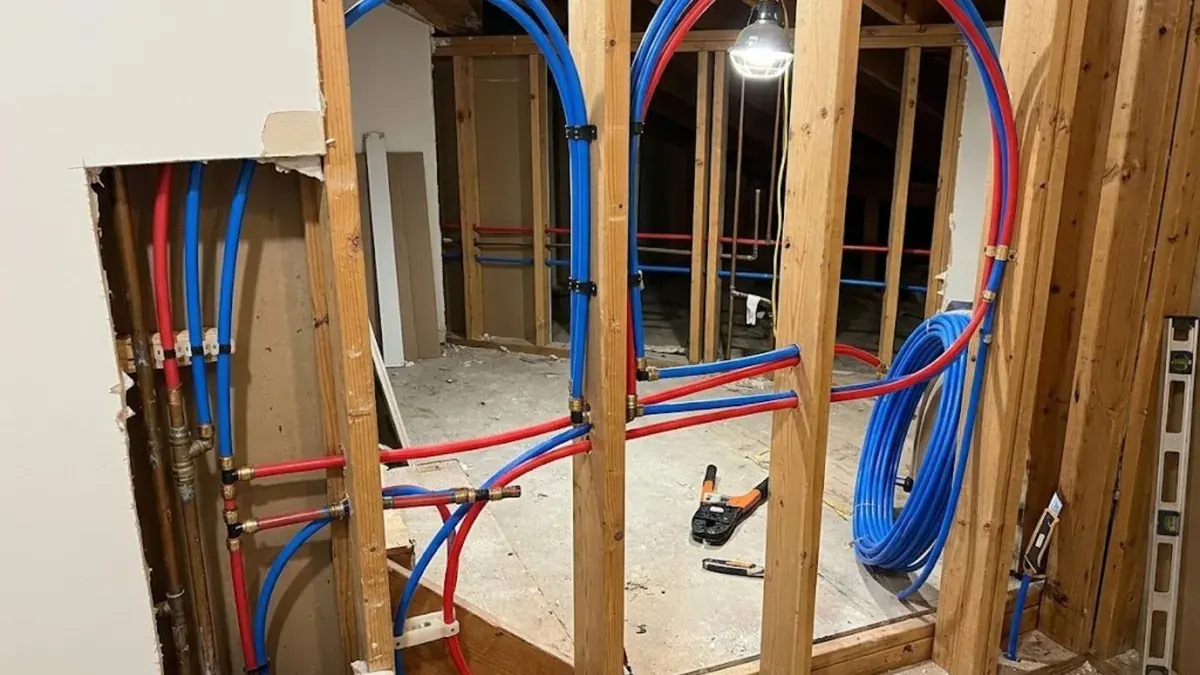
Repiping replaces the water supply pipes in your home. It is a bigger job than a repair, so it should be a considered one. The signs are usually clear: repeated leaks, discolored water, low pressure and pipes you know are made from a material with a known failure history.
Repiping in Sachse, TX covers whole-house projects and partial runs, and the plan depends on the home, its foundation and the pipe in the walls. A plumber looks at the system first and tells you whether a repair, a partial repipe or a full one makes sense.
Signs your pipes need replacing
Repeated pinhole leaks
A second or third leak in the same system suggests corrosion is widespread.
Rusty or brown water
Corroded galvanized steel releases rust into the water.
Low pressure at every fixture
Mineral and rust buildup narrow the pipe inside.
Known problem material
Polybutylene and some old galvanized systems have a history of failure.
Choosing PEX or copper
| Point | PEX | Copper |
|---|---|---|
| Install | Flexible tubing, fewer joints, faster in walls | Rigid pipe, soldered or pressed joints |
| Corrosion | Does not corrode or pit | Can pit in some water conditions |
| Cost | Usually lower | Usually higher |
| Lifespan | Long when installed to the maker's rules | Long when the water chemistry suits it |
| UV exposure | Must be protected from sunlight | Not affected |
Neither is right for every home. A plumber checks your water chemistry, your wall access and your budget before recommending one.
Repiping a slab home
In homes on concrete slabs, the old supply lines may run under the floor. A repipe usually abandons those lines and runs new ones through the attic and walls. That avoids breaking concrete and is the usual reason homeowners with repeated slab leaks choose it. Our slab leak repair page explains when one leak is a repair and when it is a sign of a system problem.
What a repipe involves
Inspect and plan
The plumber checks existing pipe, access points and fixtures, then maps a new route.
Open access
Small openings in drywall allow pipe to be run, and are planned to limit patching.
Install new lines
New supply lines are run from the main to each fixture and a manifold or branch layout is set.
Test and restore
The system is pressure tested, water is restored and the plumber shows you the new valves.
Partial repipe or full repipe
A partial repipe replaces the worst section, such as one bathroom group or the lines under a slab. It works when the rest of the system is in good shape. A full repipe is the answer when pipe throughout the house is failing, because patching one area leaves the next one to leak. The plumber should tell you what the evidence supports.
Talk through a repipe
Call to describe your home and the leaks you have had.
Repiping and Sachse homes
Sachse spans Dallas and Collin counties, and its homes range widely in age and construction. In Heritage Park, Woodbridge, Sachse Farms and Jackson Meadows (or an older area such as Salmon Estates) the pipe material depends on when the house was built and what the builder used, so the first step is to find out what your system is. A plumber can identify it at a visible section such as the water heater connection or the meter.
Repiping in nearby towns
Older homes in Garland and Wylie are where repiping comes up most often.
Safety steps during a repipe
- Know where the new main valve will be and test it after the work.
- Keep pets and children away from open walls and tools.
- Ask whether any old pipe or insulation in the walls could contain asbestos, and have it tested before disturbance.
- Open every faucet briefly after water is restored to clear air and debris.
What repiping costs
Cost factors for a repipe
Repiping is a planned job, so a written price can be set before work starts.
Insurance usually does not pay for repiping as an upgrade, though sudden water damage from a leak may be covered. Want your real number? Call (972) 903-8224.
Common questions
How long does a repipe take?
Many homes take a few days, depending on size and access. The plumber should give you a schedule and tell you when your water will be off.
Do I have to move out during a repipe?
Most people stay. Water is off for part of each day, and the plumber plans around it.
Will repiping damage my walls?
It requires some openings, which are planned to be small and are patched afterward. Painting is a separate step.
How do I know what pipe I have?
Look at visible pipe near the meter, water heater or under a sink. Copper is reddish brown, galvanized is gray and PEX is red, blue or white plastic.
Is PEX safe for drinking water?
Yes, when it is listed for potable water and installed to code. The plumber uses approved products.