
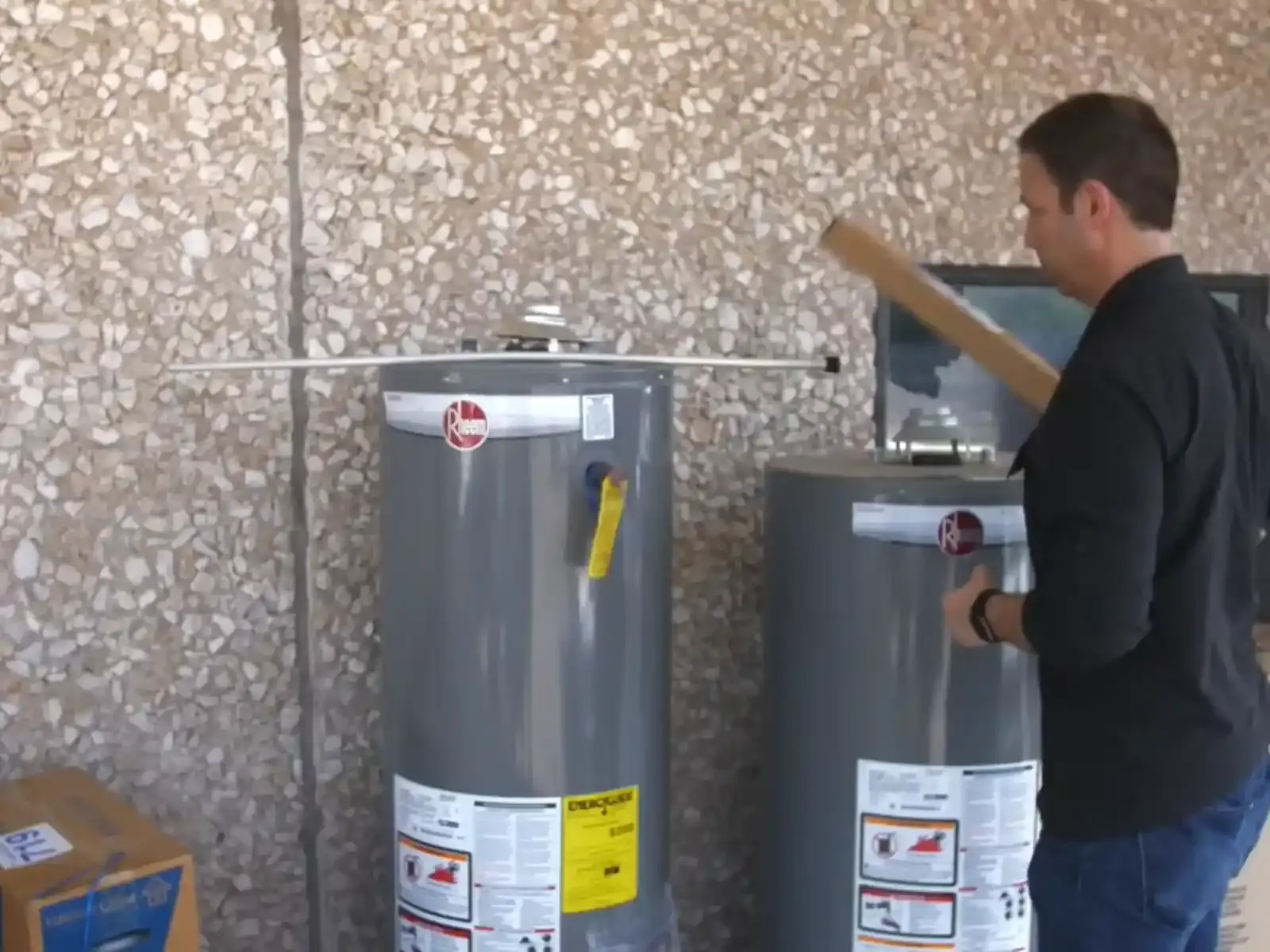
Most electric tank water heaters have two heating elements. One sits near the top of the tank and one sits near the bottom. Each has its own thermostat. The two take turns, and when one stops working the heater does its job only part of the time.
The symptoms tell you a lot. This guide covers what each one points to, the safety steps you must take first and when a repair stops making sense.
What the symptoms mean
| Symptom | Likely cause |
|---|---|
| No hot water at all | Upper element, upper thermostat, the high limit or a tripped breaker |
| Lukewarm water | Lower element or lower thermostat |
| Hot water runs out fast | Lower element failed, so only the top of the tank heats |
| Breaker trips right away | Shorted element |
| Rumbling or popping | Scale on the elements |
Safety first
Switch off the breaker
The heater runs on 240 volts, which can kill. Turn the breaker off before touching anything.
Do not open panels with power on
The thermostats and element terminals are live behind the covers.
Do not run it dry
Never switch a heater back on if the tank is empty. The element burns out in air.
Call a licensed plumber
If you are not trained in electrical work, a plumber should handle the testing and replacement.
How a plumber tests an element
With the power off and confirmed dead, the plumber removes the access panel and insulation, disconnects the wires and tests the element with a meter for continuity and for a short to the metal. A good element has a certain resistance, and a failed one reads open or shorted.
Thermostats and the high-limit switch are tested the same way, since a bad thermostat is a common cause of the same symptoms.
Replacing an element
Shut off power and water
Close the cold supply valve and switch off the breaker.
Drain part of the tank
Water has to be below the element before it comes out.
Remove and compare
The old element comes out with a special socket, and the new one must match in wattage and style.
Refill before power
Fill the tank fully and let air escape before restoring power.
The final step is the one that burns out new elements most often. If the power comes on before the tank is full, the element runs dry and fails.
Scale and sediment
Scale builds on elements and settles in the tank. It makes the heater work harder and shortens element life. Flushing the tank once a year and replacing the anode rod on schedule slows the damage.
Elements and Sachse water
The North Texas Municipal Water District, which supplies Sachse, describes its water as moderately hard. Scale from moderately hard water can form on elements within a few years. If your heater makes noise or loses capacity, scale may be the cause.
To see the hardness at your address, test your tap or ask your water utility. If you want to reduce it, our softener page explains the choices.
Repair or replace
A new element is a small repair on a heater that is otherwise sound. On a heater that is 10 or more years old, has a rusty tank or leaks, the repair only delays the end. Our replacement page explains how to weigh it. If the heater is leaking now, treat it as an emergency and call right away.
The same service covers homes in Wylie and Garland.
Preventing early element failure
- Flush the tank once a year to remove sediment
- Never switch the heater on until the tank is full
- Replace the anode rod when it is mostly consumed
- Keep the thermostat at a moderate setting
- Check the area around the heater for dampness
An anode rod is a metal rod that corrodes in place of the tank. When it is gone, the tank itself starts to corrode, and that is the end of the heater. Many plumbers check it at the same time as the elements.
When the element is not the problem
If new elements fail again, look at the thermostats, the wiring and the water. Loose wire connections overheat and burn terminals. A thermostat that is stuck closed overheats the element until it burns out. Heavy sediment buries the lower element so it cannot shed heat. A plumber can sort these out and tell you which one you have.
Reading the element label
Each element carries a label with its wattage and voltage. A replacement must match both, and the thread or flange style must fit the tank. Using the wrong wattage can overload the wiring or give you too little heat. Take a photo of the heater label and the old element to the supply house, or give the details to your plumber.
No hot water from an electric heater?
Switch off the breaker and call the 24/7 line.
Common questions
How many heating elements does a water heater have?
Most electric tank heaters have two, one upper and one lower.
Why is my water lukewarm?
The lower element or its thermostat has often failed.
Can a bad element trip the breaker?
Yes. A shorted element can trip the breaker as soon as the power is on.
How long do elements last?
Several years, depending on water quality and use. Scale shortens their life.
Does Sachse water wear out elements faster?
Moderately hard water leaves scale on elements, so an annual flush helps.